


Teeb Aden
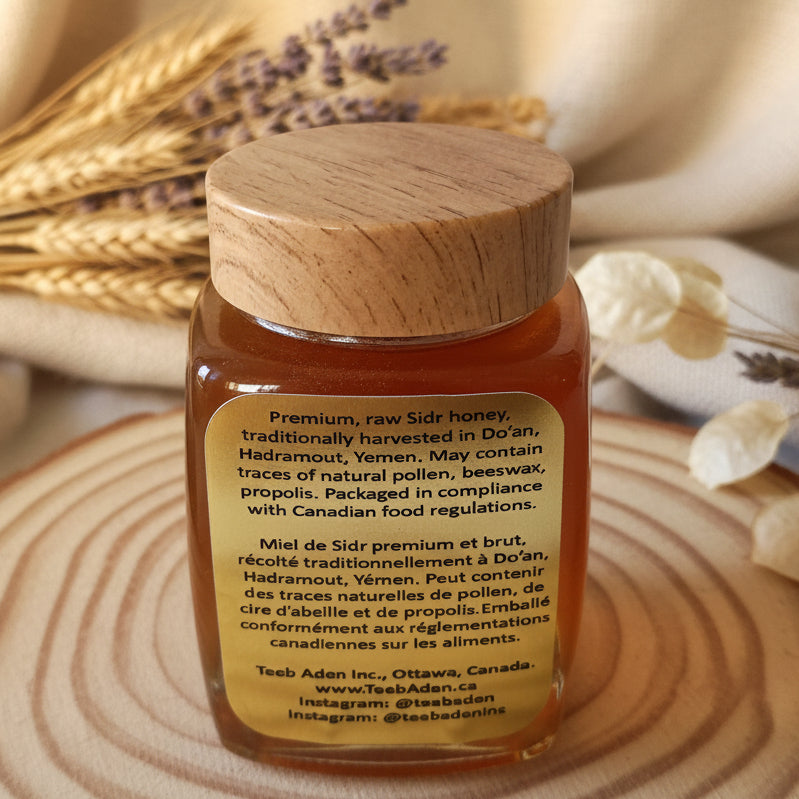
Wild Mountain Do’ani Sidr Honey عسل السدر الدوعني جبلي
Wild Mountain Do’ani Sidr Honey عسل السدر الدوعني جبلي
Couldn't load pickup availability
Sidr honey is harvested from bees that exclusively collect nectar from the Ziziphus spina-christi tree — known in Yemen as Sidr (سِدر), Nabaq (نبق), or Elb (عِلب) tree. The tree holds deep cultural and spiritual significance. It is mentioned in religious texts across multiple faiths and has been used in traditional medicine for thousands of years.
The Ziziphus spina-christi tree grows in various arid and semi-arid climates, but Sidr honey from the mountainous desert regions of Yemen is widely regarded as among the finest. This reputation comes from the area’s unique climate, rugged terrain, and long-standing traditional beekeeping practices.
Among all Sidr honey varieties, the most highly prized originates from the remote southeastern Yemeni highland–desert transition zone, particularly Wadi Do’an in Hadramout and Wadi Jaradan in Shabwa. These two valleys are part of a rugged mountainous and plateau system characterized by generally high elevations, often reaching around 1,000 metres above sea level or more in many areas.
This consistently elevated terrain contributes to their unique ecological conditions and supports the growth of wild Sidr forests. Their isolated and largely untouched landscapes result in truly monofloral honey, as bees primarily forage on Sidr blossoms during the short flowering season.
Unlike honey produced in humid environments, the dry, high-altitude climate of these valleys naturally yields honey with exceptionally low moisture content, a rich and concentrated profile, and a dense, velvety texture.
Authentic Sidr honey is exceptionally scarce. The Sidr tree flowers for only a short period each year—typically 6 to 8 weeks during the months of October and November—so the harvest season is naturally limited. Premium Sidr honey is also collected by hand using traditional methods, without modern machinery or chemical intervention. Its high value reflects this limited production and the labor-intensive harvesting process.
Important Note for Our Customers:
· Because our Sidr Honey is kept as close to its natural state as possible, it may contain traces of natural pollen, beeswax, and propolis.
Share


I met the vendor at an event I was working. I always wondered what the fuss was about Yemeni Honey. The vendor offered me a sample, and oh my goodness, it was different from any honey I'd known! They explained the difference between grocery store honey and theirs. Man, it's worth every penny.